

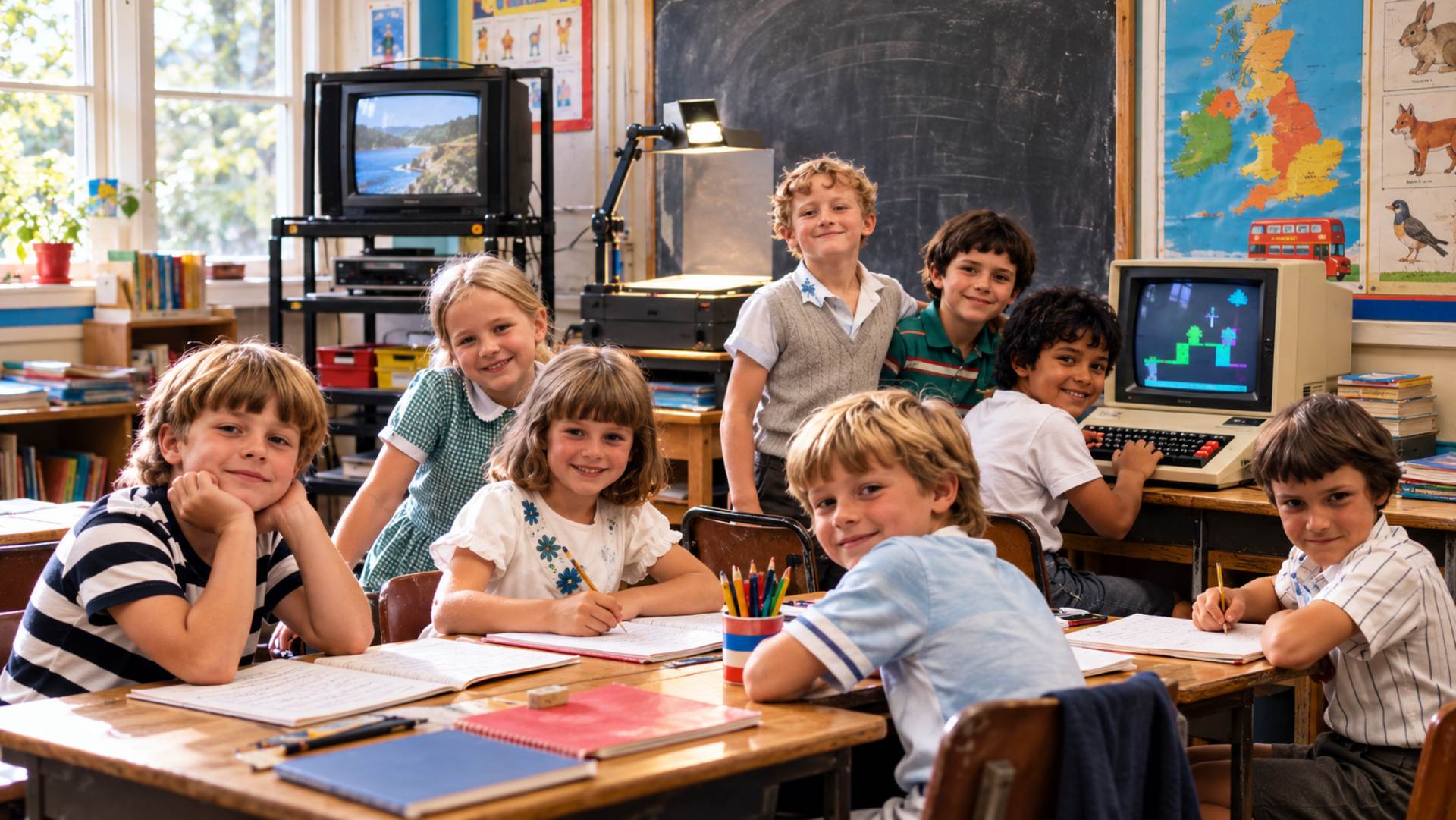
A British classroom in the 1980s was not completely different from a classroom today. Pupils still read books, completed exercises, worried about tests and waited for the bell. What has changed most dramatically is the equipment surrounding those familiar routines.
There were no interactive whiteboards, classroom tablets or online homework platforms. A television was often shared across several rooms. Teachers wrote on chalkboards, copied notes onto transparent sheets and played educational recordings from cassette tapes. A school might own only a small number of computers, and using one could be a memorable event rather than an ordinary part of every lesson.
Not every school was identical. British Schools in the 1980s varied according to the year, local authority, budget and whether the school was primary, secondary, urban or rural. Some adopted new technology early, while others continued using older equipment well into the following decade.
Even with those differences, these five memories will be familiar to many people who attended a British school during the 1980s—and surprisingly strange to children growing up with digital classrooms.
1. The Television Trolley Arriving in the Classroom
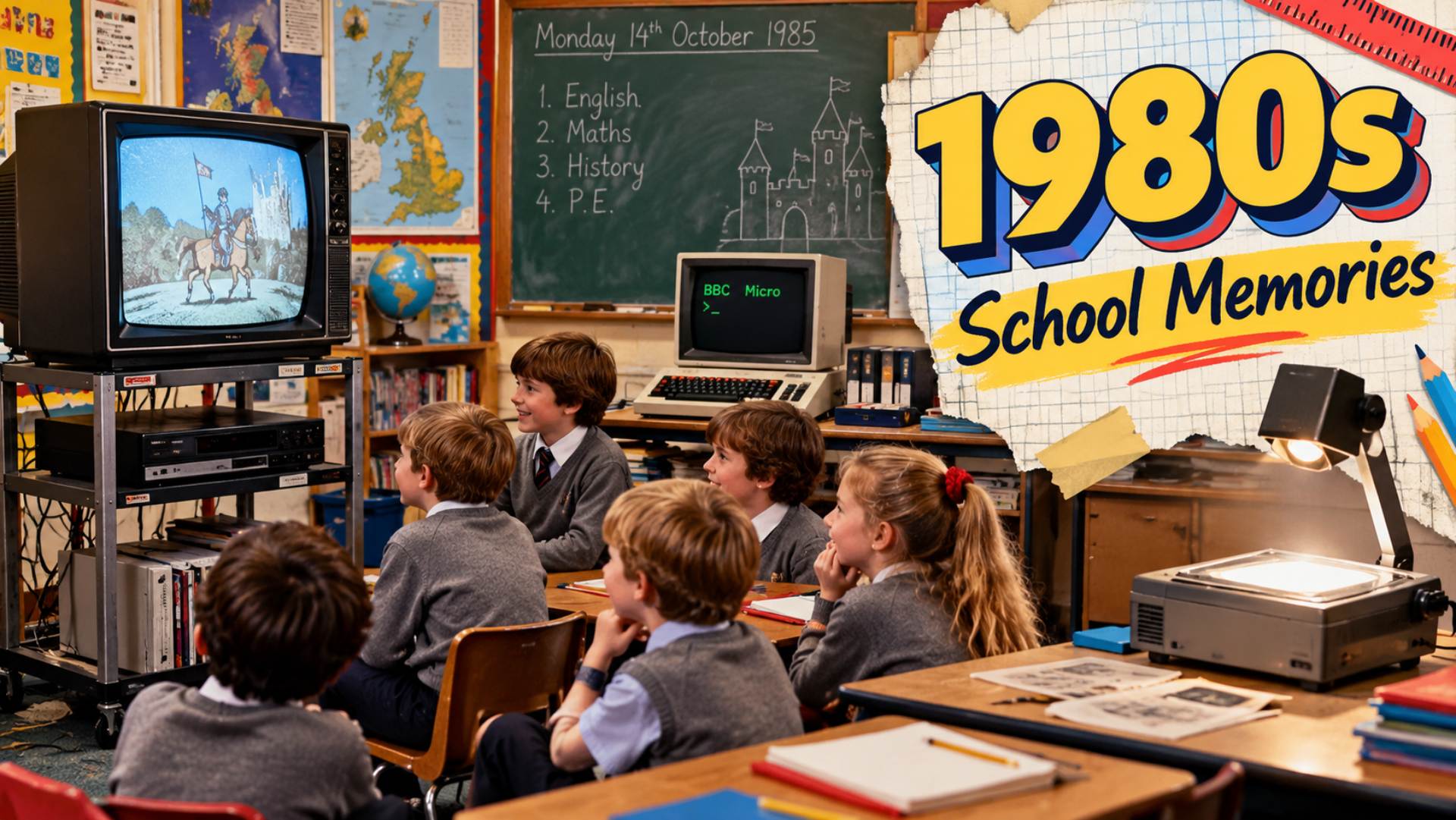
For many pupils, the sight of a television being pushed through the classroom door became one of the most memorable parts of their 1980s School Days. The television was usually a heavy box-shaped set placed on a tall metal trolley, sometimes with a video recorder on the shelf beneath it.
Because the school might own only one or two sets, teachers booked the equipment and moved it between classrooms. The trolley’s small wheels rattled along corridors, power cables had to reach a socket and everybody needed a reasonable view of a screen that now seems remarkably small.
Television programmes followed a schedule
Before widespread classroom video recording, educational broadcasts had to be watched when they were transmitted. Teachers used printed schedules to know when a particular programme would begin. If a lesson ran late or the equipment was not ready, the class could miss the opening.
Schools television covered subjects such as science, history, geography, languages, music and current affairs. A programme might introduce a topic that the teacher would discuss afterwards or show places and processes that could not be demonstrated easily in the classroom.
The presentation had its own ritual:
- The trolley was positioned near a power socket.
- The aerial or other connection was checked.
- Curtains or blinds might be closed to reduce glare.
- Pupils moved their chairs or sat where they could see.
- The teacher adjusted the channel, volume and picture.
- Everyone waited for the programme to start.
Once video recorders became more common, teachers could record programmes and play them at a convenient time. Even then, the correct cassette had to be found, rewound and checked before the lesson.
Why children today might find it strange
A modern classroom can display a video instantly on a large screen. The teacher can search, pause, rewind, add captions or send the link to pupils.
In the 1980s, the programme belonged to the schedule and the equipment belonged to the school. Seeing a video was a shared event that required physical preparation.
Details people remember
- The sound of the trolley in the corridor
- A teacher asking the class to move their chairs
- Reflections on the glass screen
- A picture that needed tuning
- Pupils at the back trying to see
- The excitement of a lesson involving television
- The teacher stopping the tape to ask questions
Moments like these often became lasting Childhood School Memories, precisely because television lessons felt different from the ordinary classroom routine.
What replaced it?
Video projectors, interactive whiteboards, classroom computers and online streaming made moving a television between rooms unnecessary. What once required a trolley can now happen through a browser in seconds.
2. Overhead Projectors and Transparent Sheets
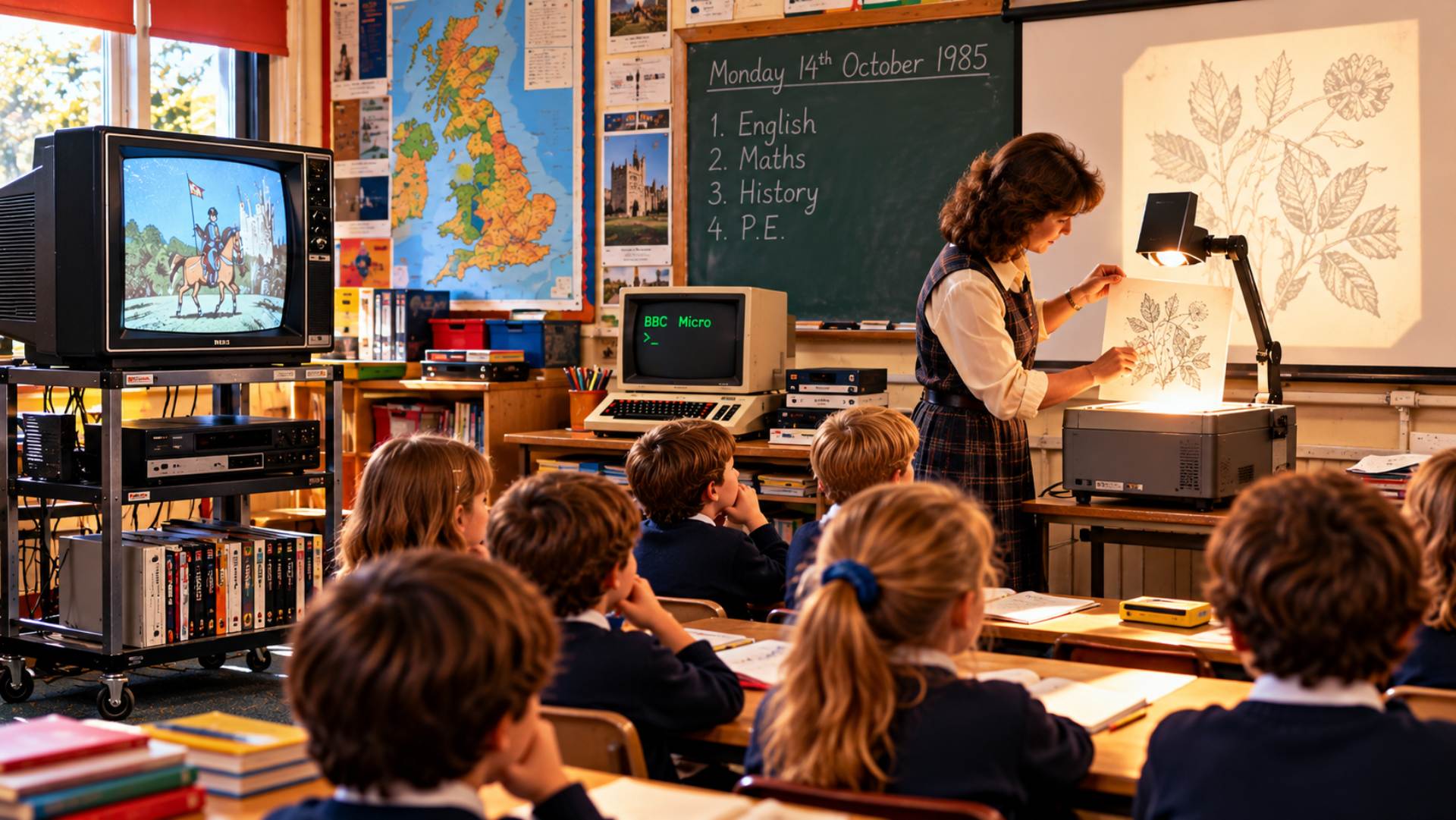
The overhead projector allowed a teacher to display notes, diagrams or calculations on a wall or pull-down screen. It was one of the most useful pieces of classroom technology before digital projectors became common.
The machine had a bright illuminated surface, a vertical arm and a lens-and-mirror assembly at the top. A transparent plastic sheet, usually called an acetate or transparency, was placed on the lit stage. Whatever appeared on that sheet was projected at a much larger size.
Teachers could write while facing the class
Unlike a chalkboard, the overhead projector allowed the teacher to remain facing the pupils while writing. Special pens could be used directly on the transparency. Prepared sheets might contain printed diagrams, maps or typed notes.
Teachers could also build an explanation in layers. One transparent sheet might show the outline of a diagram, while another added labels or extra information. In mathematics, a calculation could be revealed step by step. In geography, different features could be placed over a base map.
The idea was simple and effective, but the equipment had habits of its own.
The projector created a particular classroom atmosphere
In Old-School British Classrooms, the room often had to be darkened while the projector produced heat and sometimes made a steady fan noise. Dust, handwriting and accidental marks became enormous when projected onto the wall.
Teachers learnt to write within the visible area and avoid blocking the light. Pupils learnt that the lesson might pause while the image was focused or the correct sheet was found in a stack.
Transparencies could be cleaned and reused, but permanent and non-permanent pens needed to be kept separate. Using the wrong pen could turn an erasable sheet into a permanent record.
Why children today might find it strange
Digital slides can contain animation, video, links and perfectly formatted text. An overhead transparency was a physical object. It could be dropped, written on, scratched, placed upside down or returned to the wrong folder.
There was no undo button. If a teacher made a mistake with a permanent pen, the correction remained visible unless the sheet was replaced.
Details people remember
- The warm light from the projector
- The large shadow of a teacher’s hand
- Coloured pens used for different parts of a diagram
- The image being slightly out of focus
- Transparencies stacked in the wrong order
- Notes copied quickly before the sheet was removed
- The fan continuing after the explanation ended
What replaced it?
Computer presentations and digital projectors performed the same basic job with much greater flexibility. Interactive whiteboards then allowed teachers and pupils to write directly on a digital display, save the results and return to them later.
The overhead projector looks primitive now, but it solved an important problem: one small sheet could become visible to an entire class.
3. Chalkboards, Dusty Dusters and Blackboard Monitors
The chalkboard was the centre of many 1980s classrooms. Teachers wrote explanations, homework, dates, diagrams and spelling lists across its surface. Pupils copied them into exercise books before the board was wiped for the next subject.
Some boards were black, while others were green. Both used sticks of white or coloured chalk and a felt or wooden-backed duster.
Writing on the board was a physical skill
Clear chalkboard writing required large, controlled movements. The teacher needed to judge how much space a sentence or calculation would occupy before reaching the edge. A broken piece of chalk could still be used, but eventually it became too small to hold comfortably.
Chalk made dust. It settled in the tray beneath the board, marked clothes and covered the duster. Wiping a full board could produce a visible cloud, particularly when the duster had not been cleaned for some time.
The board also made a range of sounds. Most were ordinary, but an awkward angle could produce the high squeak that caused an entire class to react.
Pupils sometimes helped maintain it
In some schools, a pupil might be asked to wipe the board, clean the duster or act as a blackboard monitor. The job could feel like a privilege because it involved leaving the desk and helping the teacher.
Cleaning a heavily used board properly took effort. A dry duster moved most of the chalk, but the surface could remain grey with old writing. A damp cloth produced a darker, cleaner board, although it had to dry before new chalk worked well.
Copying before the board was erased
In Old-School British Classrooms, the room often had to be darkened while the projector produced heat and sometimes made a steady fan noise. If the teacher began wiping too soon, hands went up and voices called for more time.
Modern digital notes can be saved, photographed or distributed online. Chalk disappeared the moment the duster passed over it.
Why children today might find it strange
- Lessons could leave dust on hands and clothes.
- Notes were not automatically saved.
- Pupils had to copy information before it vanished.
- A small piece of chalk remained useful.
- Cleaning the board could be a classroom responsibility.
- The teacher could not move written text or resize a diagram.
What replaced it?
Whiteboards reduced dust and made colour easier to use, although dried pens introduced a different frustration. Interactive whiteboards added digital files, internet access and the ability to save or revisit material.
Chalkboards have not disappeared completely, but they no longer define the ordinary British classroom in the way they once did.
4. Waiting for a Turn on the BBC Micro
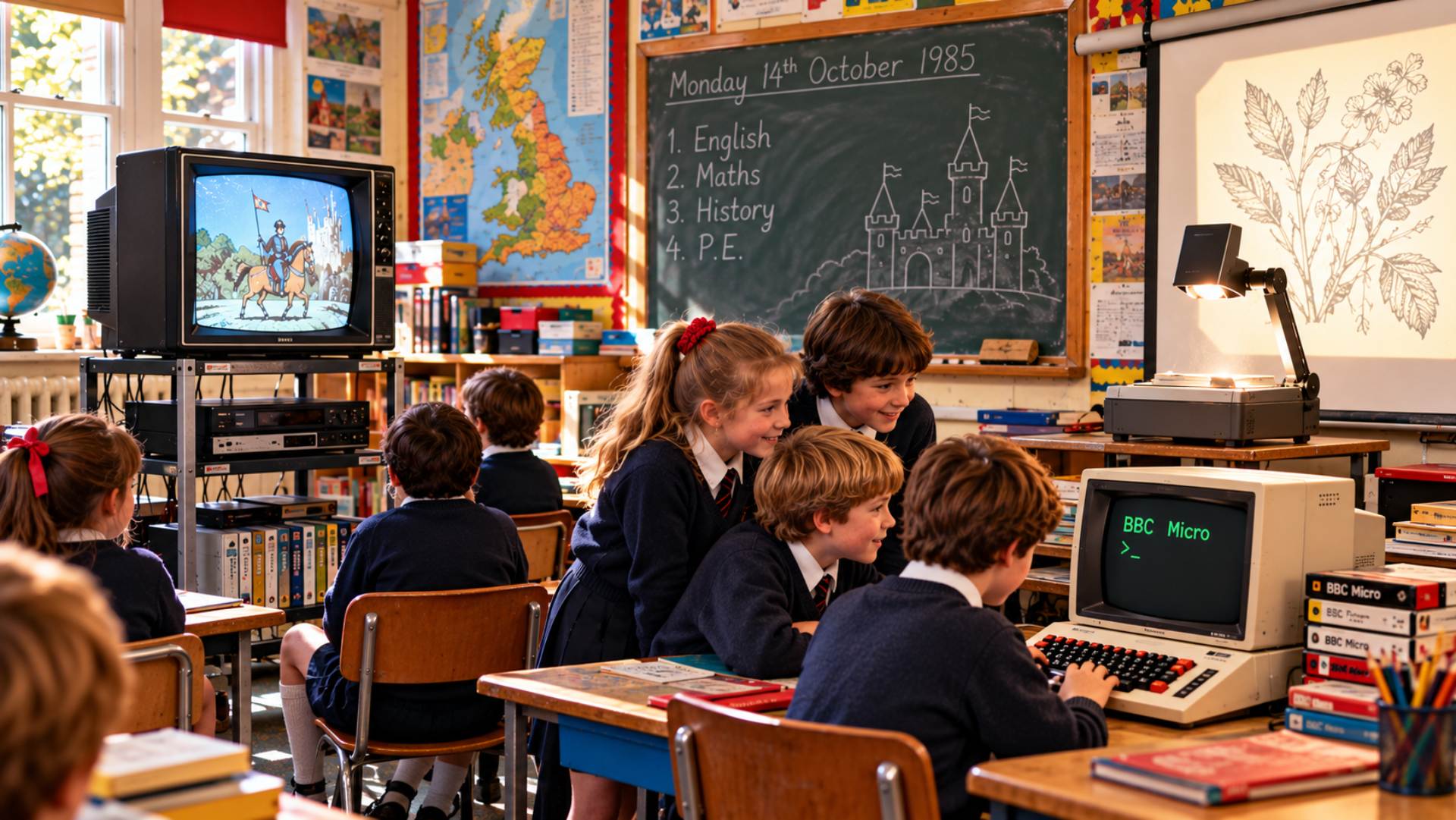
The arrival of computers in British schools was one of the decade’s most important educational changes. The BBC Computer Literacy Project helped introduce computing to a wide public, while the BBC Micro became strongly associated with classrooms.
For many pupils, however, computer access was limited. A school might have one machine in a classroom, a small group in a special room or a computer shared according to a timetable. One device could attract a cluster of children watching while a classmate used the keyboard.
The computer did not hide how it worked
The BBC Micro started at a command prompt rather than opening a colourful desktop full of apps. Pupils might learn basic programming, type commands, control a simple graphic or use educational software.
Programs could be stored on cassette or floppy disc depending on the school’s equipment. Loading took time, and the process did not always succeed. The teacher or a confident pupil might become the person everyone relied upon when the software refused to start.
Programming lessons encouraged pupils to give precise instructions. A missing character, incorrect line number or spelling mistake could stop a program from running. Debugging meant finding the error rather than expecting the computer to guess what the user intended.
One computer created a social lesson
Limited access meant pupils often worked in pairs or groups, creating the kind of Nostalgic British School Memories that many former pupils still associate with their first encounters with computers. One person typed while others read the instructions, suggested changes or waited for their turn.
This was not always efficient, but it made computing visibly collaborative. The machine felt valuable because time on it was limited.
Some pupils became fascinated and continued experimenting beyond the task. Others found the commands confusing and preferred to let a more confident classmate take control. That difference helped create the first generation for whom computing could become a hobby or future career.
Why children today might find it strange
- An entire class might share only a few computers.
- Programs could load from cassette tape.
- The screen opened with a command prompt rather than familiar icons.
- Pupils typed code from printed instructions.
- Saving work required physical media.
- A failed load or syntax error could consume much of the lesson.
- There was no web search for instant help.
What replaced it?
Computer suites brought more machines into schools, followed by classroom laptops, tablets and internet-connected devices. Modern education platforms now distribute work, save files automatically and allow collaboration from different locations.
The BBC Micro was limited by modern standards, but it taught an important lesson: a computer was not only something to watch or play. It was a machine pupils could instruct.
5. Learning From Cassette Recorders
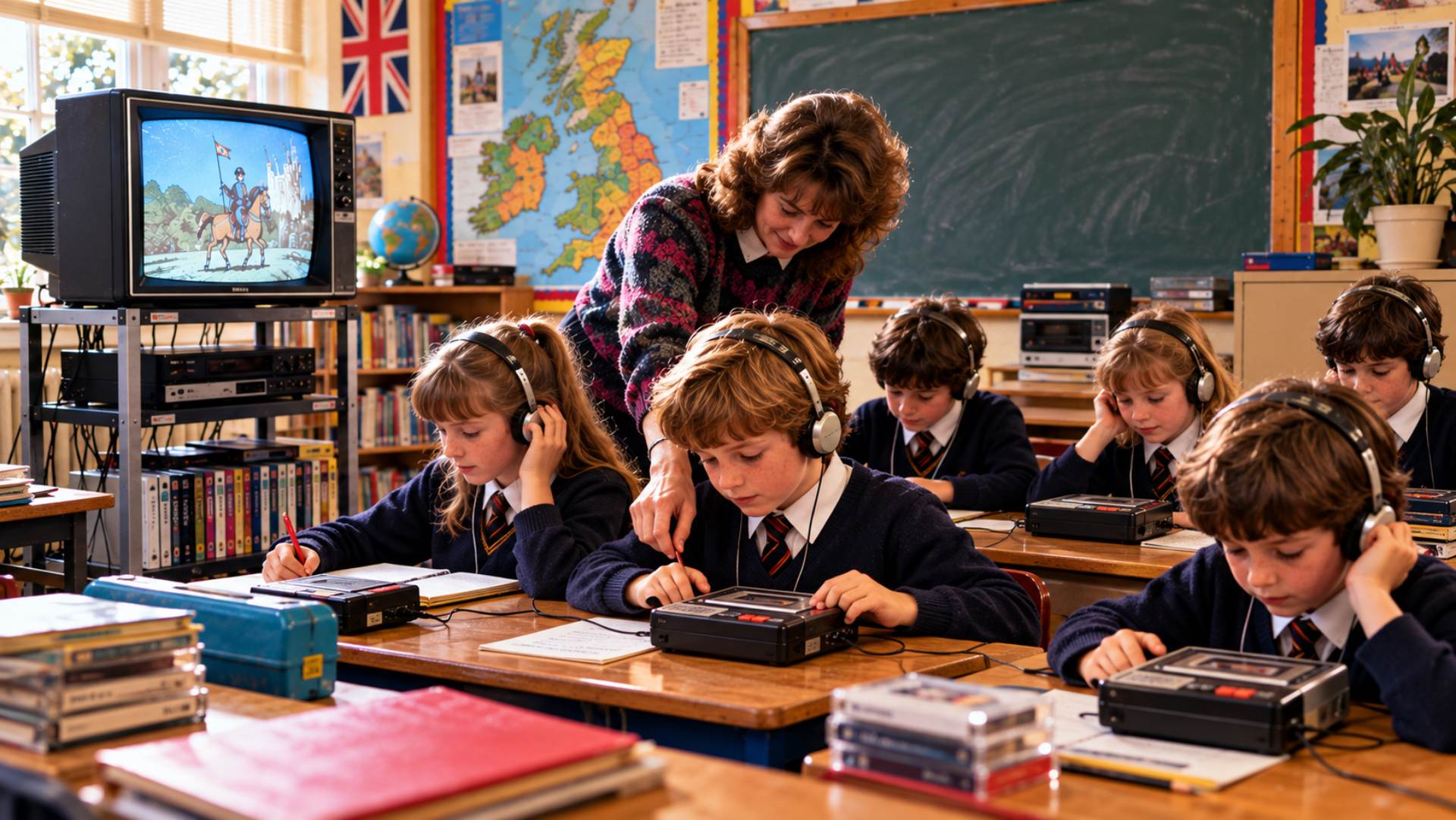
The cassette recorder was one of the most adaptable pieces of equipment used in School Life in the 1980s. It could play songs, stories, language exercises, drama recordings, sound effects or instructions for physical activity. It could play songs, stories, language exercises, drama recordings, sound effects or instructions for physical activity.
A teacher carried the recorder into the classroom, connected it to a socket or relied on batteries, inserted the cassette and pressed play. The lesson then depended on the tape being in the correct place.
Finding the right section required judgement
A cassette had no clickable chapter list. The teacher used fast-forward and rewind, stopped the tape and listened to check the position. A counter on some machines helped, but it was not the same as a precise digital timecode.
If the class needed to hear a sentence again, the teacher pressed stop, rewound for a few seconds and tried to find the beginning. Rewinding too far meant hearing part of the previous exercise. Not rewinding far enough meant missing the opening words again.
Language lessons often used listen-and-repeat exercises. A voice spoke a word or sentence, followed by a carefully timed gap in which pupils responded together. Music lessons used tapes for songs and accompaniment. Younger classes listened to stories while following a book or completing an activity.
Tape problems interrupted the lesson
Cassettes could stretch, tangle or become worn. Batteries could weaken, causing playback to slow and voices to sound strangely low. The tape might start on Side B when the required material was on Side A.
A teacher who knew the recorder well could solve these problems quickly. A loose cassette reel might even be tightened with a pencil before the lesson continued.
Recording was possible too. Pupils could make spoken presentations, practise language work or create simple radio-style programmes. Hearing one’s own recorded voice was often an uncomfortable surprise.
Why children today might find it strange
- Audio had to be found by rewinding and listening.
- The class shared one playback device.
- Weak batteries changed the sound.
- A tangled tape could stop the lesson.
- Recordings could be accidentally erased.
- There were no subtitles, variable playback speeds or instant transcripts.
- Copying audio reduced its quality.
What replaced it?
CD players offered direct track selection, followed by computer audio, online libraries and streaming. Teachers can now jump to a precise second, change playback speed, display captions and distribute the recording to pupils.
The cassette recorder required more patience, but it brought voices, music and stories into classrooms long before every room had an internet connection.
Quick Comparison: The 1980s Classroom and Today
| 1980s classroom experience | Modern equivalent |
|---|---|
| Shared television on a trolley | Interactive display or streamed video |
| Notes on transparent acetate | Digital presentation slides |
| Chalkboard wiped after the lesson | Saved interactive-whiteboard pages |
| A few shared BBC Micro computers | Individual or shared laptops and tablets |
| Cassette recorder for classroom audio | Streaming, apps and digital audio files |
The modern tools are faster and more flexible. The older ones made their physical processes impossible to ignore.
What Did These Old Classroom Tools Teach?
It is easy to romanticise the past and forget the inconvenience. Nobody benefited when a cassette tangled or a television programme began before the class was ready.
Still, the equipment encouraged certain habits:
- Pupils paid attention because material could not always be replayed easily.
- Notes had to be copied before the board was wiped.
- Limited computer time made each turn valuable.
- Teachers planned around shared resources.
- Pupils learnt that technology required setup, maintenance and patience.
- A small technical problem could become a lesson in practical problem-solving.
Modern technology removes many barriers and can make learning more accessible. It also makes the machinery less visible. A streamed video appears instantly, files save automatically and search tools answer questions before a pupil has opened a reference book.
The difference is not that one era was better. Each classroom trained pupils to deal with the tools available to them.
Other British 1980s School Memories
Many former pupils may also remember these Things Kids Did at School in the 1980s and the everyday objects that surrounded them:
- Exercise books covered in wallpaper or brown paper
- Printed worksheets with distinctive ink and paper smells
- Fountain pens and ink cartridges
- Wooden rulers stored on teachers’ desks
- Slide projectors and carousels
- Filmstrip viewers
- School radio broadcasts
- Printed encyclopaedias and library index cards
- Metal-framed chairs and individual wooden desks
- Teachers using bells, whistles or hand signals rather than electronic systems
Not every memory belongs exclusively to the 1980s. Several began earlier and continued into the 1990s, which is exactly how real school life changes: gradually rather than on the first day of a new decade.
FAQs
Did all British schools have televisions in the 1980s?
No. Provision differed by school and year. Many schools had access to television equipment, but it was often shared between classes rather than permanently installed in every room.
What was a television trolley?
It was a wheeled stand carrying a heavy television, often with a video recorder on a lower shelf. Staff moved it between classrooms when a lesson required video.
Why did teachers use overhead projectors?
They allowed notes, diagrams and calculations on a small transparent sheet to be enlarged for the entire class. Teachers could write while facing pupils and reuse prepared material.
What was the BBC Micro used for in schools?
It supported computer-literacy lessons, BASIC programming, educational software and games. Access varied, and pupils often shared a small number of machines.
Did schools use cassette tapes for lessons?
Yes. Cassettes were used for language exercises, music, stories, drama, recorded instructions and pupil projects.
Were blackboards still common in the 1980s?
Yes, although whiteboards and other technologies appeared at different times in different schools. Chalkboards remained a familiar classroom feature throughout much of the decade.
Were 1980s classrooms better than classrooms today?
They were different, not necessarily better. Modern tools offer greater access, flexibility and support. Older classrooms required more patience and made pupils more aware of how the equipment worked.
A Classroom Built Around Shared Moments
The strongest difference between a British 1980s classroom and a modern one is not simply the age of the equipment. It is the way that equipment organised the class.
Everyone watched the same small television. The teacher projected one transparent sheet. Pupils copied from the same board, waited for the same computer and listened to the same cassette recorder.
Those limitations could be inconvenient, but they also created British School Traditions Children Wouldn’t Recognise today. The arrival of the television trolley changed the mood of the room. The arrival of the television trolley changed the mood of the room. A successful computer program felt like a class achievement. Even a tangled cassette could become part of the story people remembered years later.
Children today would understand the purpose of all five tools. What they might not recognise is the waiting, preparation and collective attention each one demanded.





 in London.