

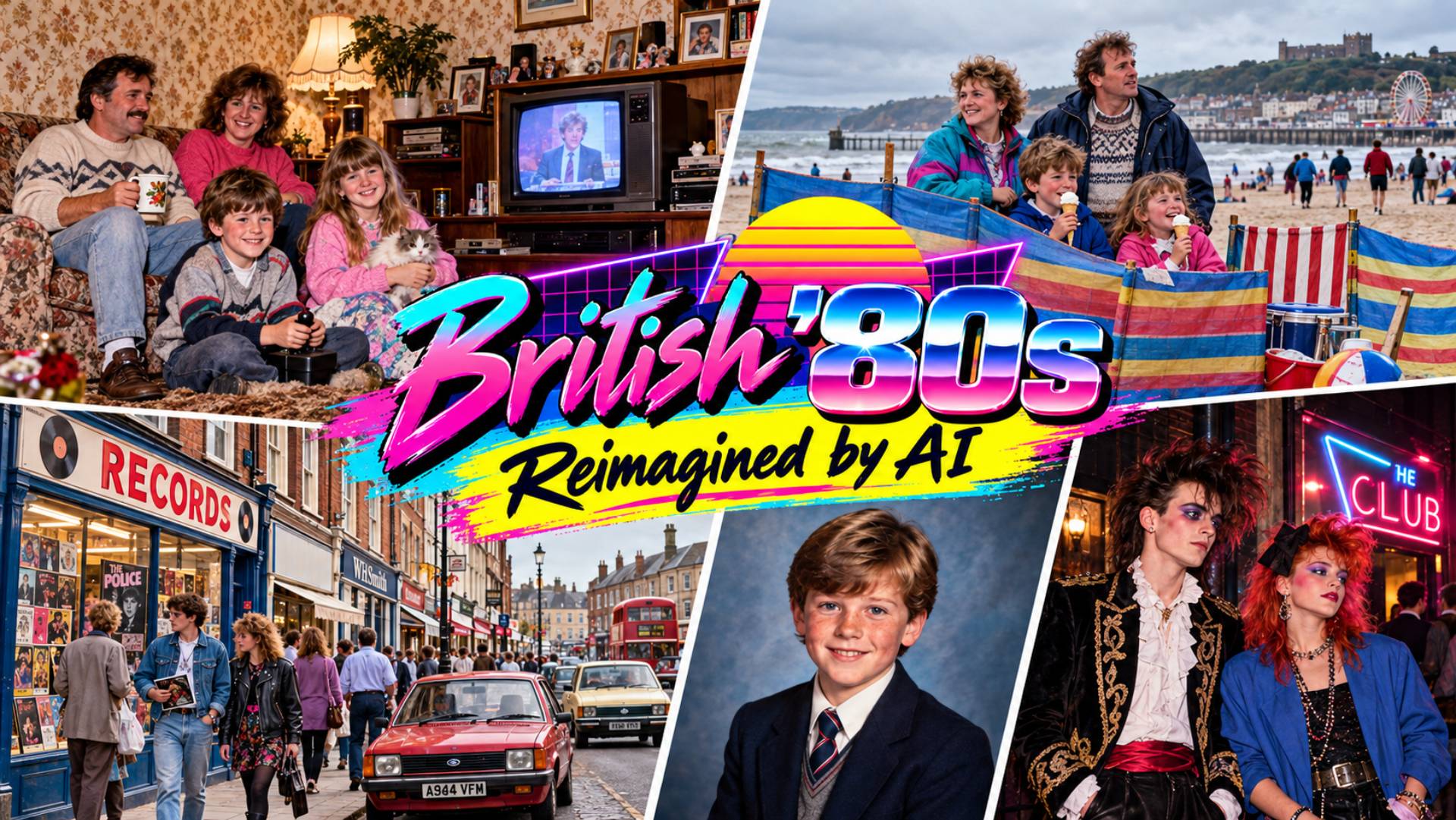
Britain in the 1980s was more varied than the neon-coloured version usually presented by films, advertisements and AI-generated pictures. A real family photograph might show a floral sofa, a practical jumper and an older television. A seaside holiday could mean cloudy skies and windbreaks rather than perfect sunshine. A high street was more likely to contain a newsagent, record shop and building society than a row of glowing signs.
That everyday detail is exactly what makes the decade such good material for AI image creation.
With a clear photograph and a carefully written prompt, you can explore 1980s Britain With AI by imagining yourself in a British sitting room, on a seaside holiday, outside a local record shop, in a school portrait or preparing for a night out.The key is to recreate one coherent moment rather than fill the image with every famous symbol of the decade.
Here are five iconic British 1980s scenes you can recreate with AI, along with the details, prompts and corrections needed to make each one feel believable.
Before You Create Your 1980s Scene
Start with a clear photograph in which the person’s face is visible and well lit. If several people are included, make sure no face is hidden behind hair, hands or another person.
Your prompt should establish:
- An exact year rather than the entire decade
- A specific British location or type of place
- The reason the photograph is being taken
- Believable clothing and hairstyles
- Two to four useful period details
- A photographic style suitable for the scene
- Modern objects that must be excluded
Include an identity-preservation instruction near the beginning:
This does not guarantee a perfect likeness, particularly in a large group photograph, but it tells the AI what matters most.
1. A Traditional British Family Sitting Room
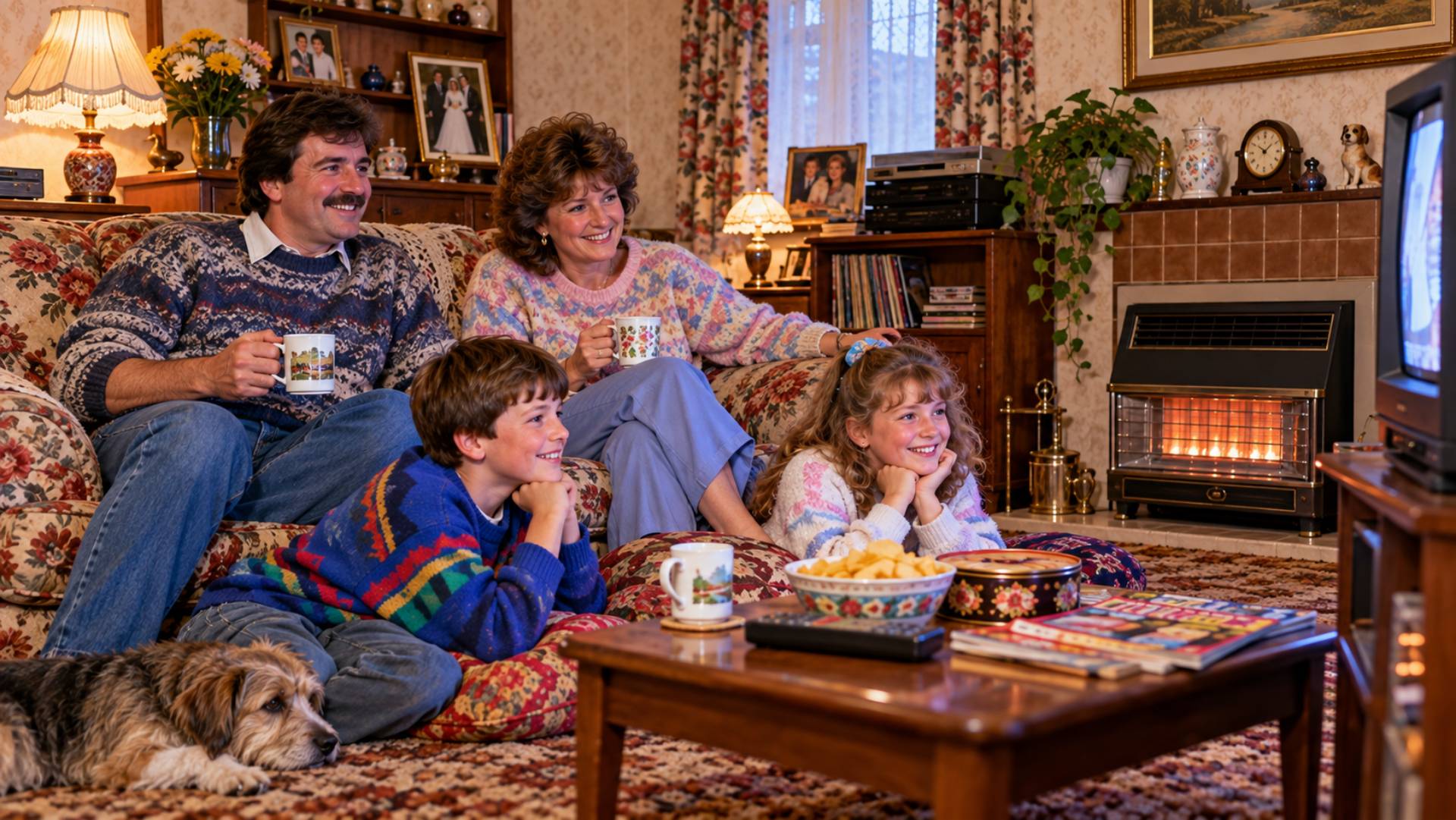
The family sitting room is one of the most recognisable settings in a British photo album. It was where birthdays were celebrated, Christmas presents were opened, relatives gathered and somebody eventually asked everyone to look at the camera.
An authentic room should not resemble a perfectly designed retro exhibition. British families usually replaced furnishings gradually. A photograph taken in 1985 could contain a 1970s sofa, an older gas fire and a newly purchased VHS recorder. That mixture gives the room a history. This kind of restraint is especially important when creating AI-Generated British Scenes, because believable details usually work better than filling the room with obvious decade-specific props.
Details that make the scene believable
Choose a few of the following:
- A floral or textured three-piece suite
- Patterned carpet or wallpaper
- Heavy curtains
- A gas or electric fire
- A wooden television cabinet
- Framed school or family photographs
- A corded telephone
- Lace covers or a small side table
- A newspaper or television listings magazine
Avoid using all of them. A sofa, television cabinet, gas fire and two family photographs may be enough.
Clothing should also feel ordinary. Knitted jumpers, cardigans, patterned blouses, collared shirts, high-waisted trousers and simple children’s clothes will usually look more convincing than bright shell suits or glamorous partywear.
The camera matters as much as the room. Many family snapshots used direct flash, producing firm shadows and slightly uneven light. Poses were not always elegant, and the framing might leave too much room above people’s heads. These imperfections can make the image feel genuine.
Prompt
Transform the uploaded photograph into a realistic British family snapshot taken in a modest Birmingham sitting room in 1985. Preserve every person’s recognisable facial identity, age, natural skin tone, facial structure, body proportions and family resemblance. Dress the adults in ordinary mid-1980s knitwear, a patterned blouse and high-waisted trousers, and dress the children in simple jumpers and corduroy trousers or an age-appropriate dress. Include a floral sofa, patterned carpet, gas fire and wooden television cabinet. Allow one or two furnishings to look older than the decade. Use direct compact-camera flash, natural skin texture, slightly imperfect framing and the appearance of a newly developed 35mm colour print. Exclude modern devices, neon lighting, luxury décor, celebrity styling and readable invented text.
Common mistake to avoid
Do not place a home computer, arcade machine, boombox, record player, Rubik’s Cube, VHS recorder and portable television in the same small room. An authentic home contains possessions; a fake-looking image contains props.
2. A Great British Seaside Holiday
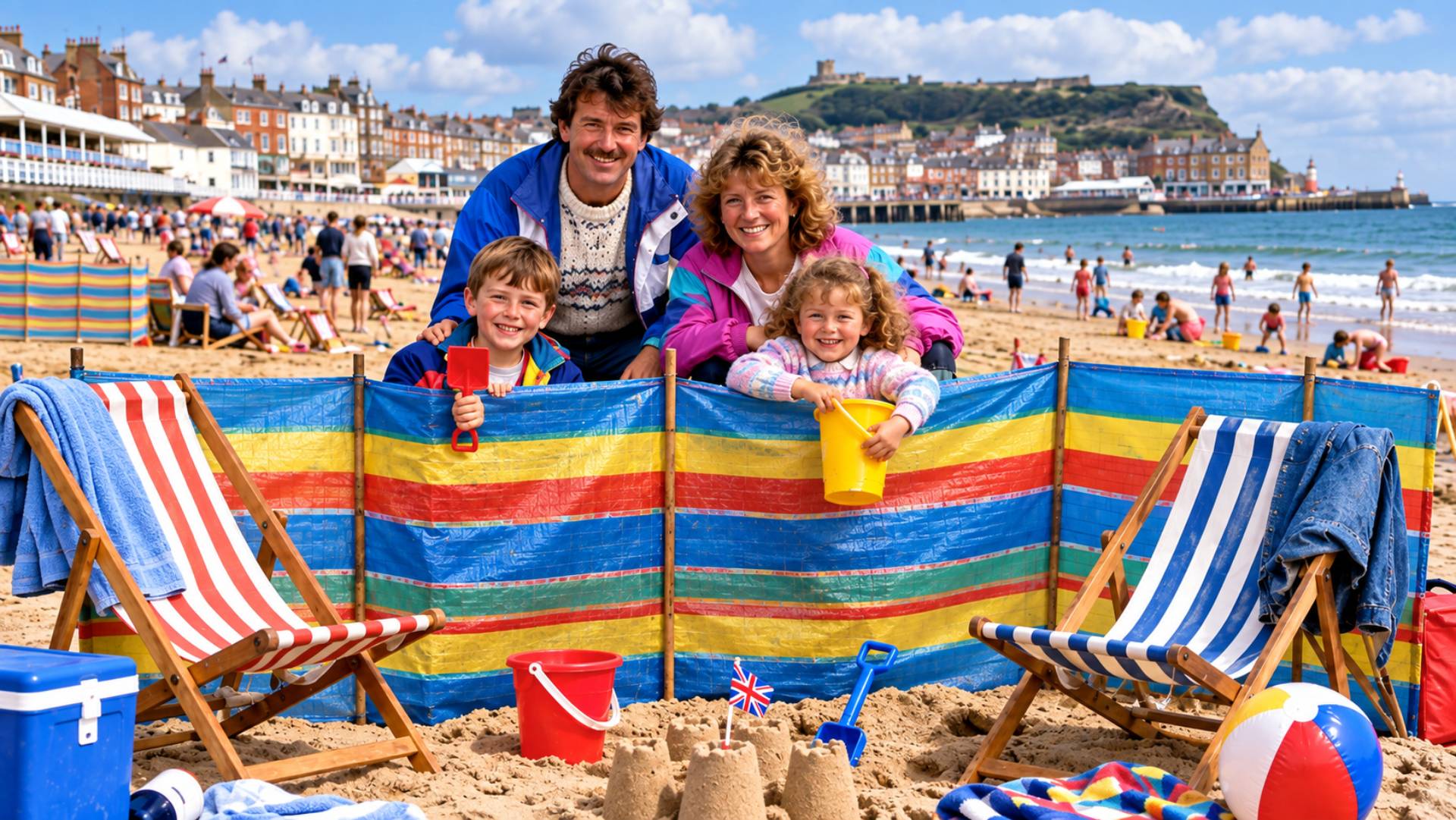
The British seaside holiday combines family nostalgia with instantly recognisable visual details. Piers, promenades, amusement arcades, striped windbreaks, deckchairs and buckets and spades can all establish the setting.
The weather is what often separates a believable British scene from an AI fantasy. Not every holiday photograph was taken beneath a flawless blue sky. Families continued to enjoy the beach while wearing jumpers, fastening windbreakers or sheltering behind a windbreak.
A location makes the prompt stronger. Blackpool, Brighton, Bournemouth, Scarborough and smaller coastal resorts did not look identical. Name one place, then include details that suit it rather than combining every British seaside landmark. If you want to Recreate the 1980s With AI convincingly, this location-specific approach helps the finished image feel grounded in a real British holiday rather than a generic retro setting.
Details that make the scene believable
- A striped windbreak
- Folding deckchairs
- Buckets and spades
- A cool or changeable sky
- A promenade or pier in the distance
- Practical jumpers or light jackets
- A modest picnic
- Slightly crowded public beach space
- A simple guest-house or holiday-camp setting
The photograph should feel casual. Somebody may be looking away, a child may be concentrating on a sandcastle and the horizon need not be perfectly level. Ask for a consumer-camera snapshot instead of a tourism advertisement.
Prompt
Recreate the people in the uploaded photograph during a family seaside holiday in Scarborough in the summer of 1988. Preserve every person’s face, age, natural skin tone, body proportions and family resemblance. Dress them in ordinary late-1980s holiday clothes, including light jumpers and windbreakers suitable for cool coastal weather. Place them behind a striped windbreak with two deckchairs, buckets and spades, a busy beach and the distant promenade. Use changeable cloudy daylight, candid tourist-camera composition, gentle film grain and realistic late-1980s colour. Keep expressions natural and slightly unposed. Exclude tropical weather, modern buildings, smartphones, contemporary logos, cinematic lighting and fashion-model styling.
Common mistake to avoid
Do not make the beach empty, tropical and perfectly lit. A British seaside photograph becomes more convincing when it includes wind, cloud, other holidaymakers and the small inconveniences people remember affectionately.
3. A 1980s British High-Street Shopping Trip
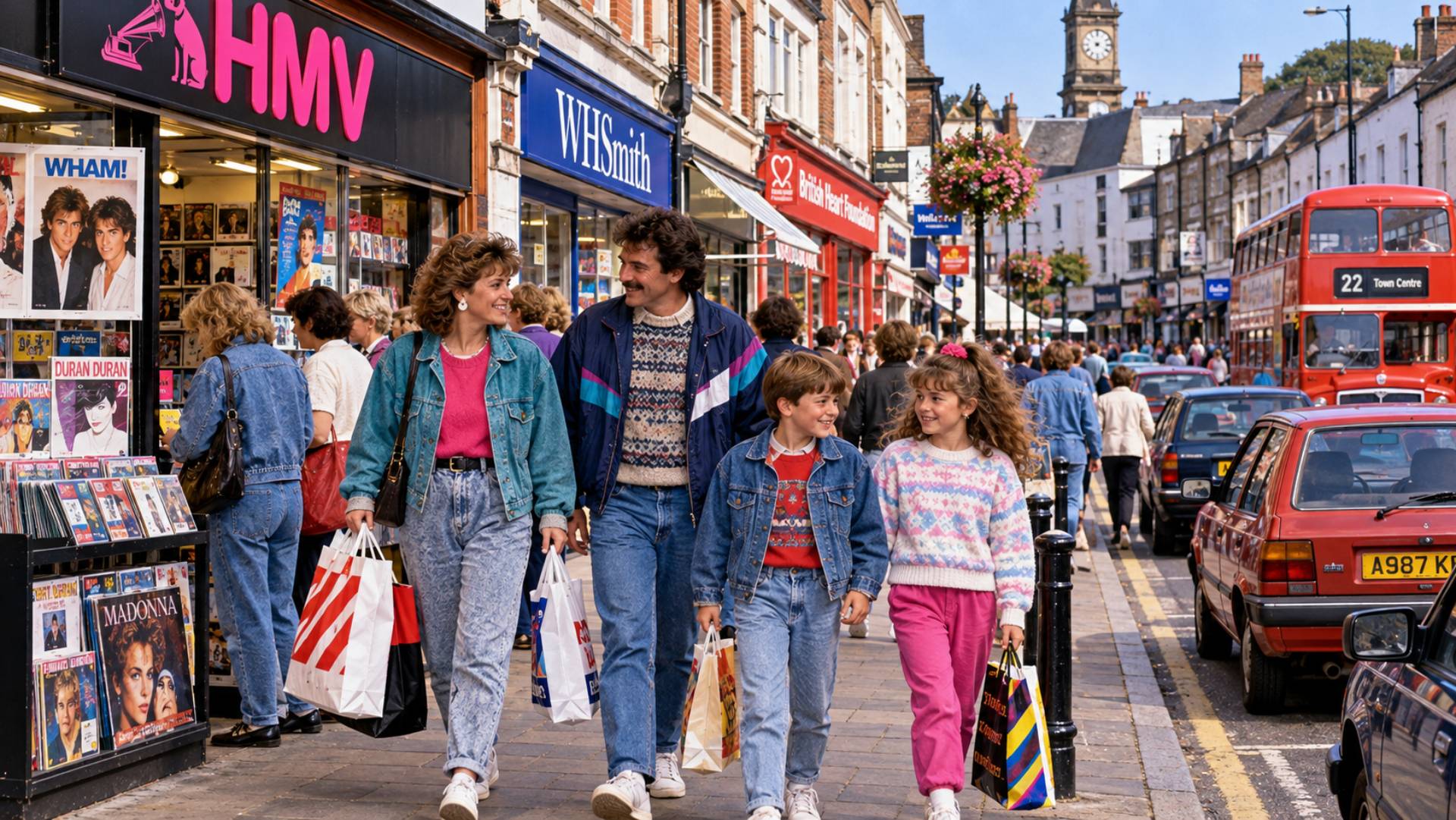
The British high street of the 1980s was both a shopping centre and a meeting place. People visited record shops, newsagents, department stores, banks, building societies, electrical retailers, cafés and photo-processing counters. Window displays and signs competed for attention without sharing a carefully coordinated design. These everyday shopping habits, local businesses and mixed streetscapes were an important part of Classic British 80s Culture beyond the better-known fashion and music imagery of the decade.That familiar awkwardness is one reason school portraits remain such a strong source of British 1980s Nostalgia for people recreating family-album imagery.
AI often turns a British street into central London. Red buses, black cabs, Big Ben and telephone boxes appear even when the prompt names another city. A more authentic result comes from choosing a regional high street and describing its ordinary function.
Manchester, Birmingham, Glasgow, Cardiff, Newcastle, Leeds and hundreds of smaller towns each offer a stronger setting than the vague instruction “British street”. Brick or stone buildings, bus shelters, road markings, period cars and practical clothing can communicate place without famous landmarks.
Details that make the scene believable
- Independent shopfronts
- A record shop or newsagent
- A building society
- A bus stop with paper timetables
- Period cars and delivery vans
- Shoppers carrying simple paper or plastic bags
- An overcast sky or wet pavement
- Handwritten notices in windows
- Mixed shop signs rather than a polished row
Generated text is often unreliable, so ask for signs with no readable wording or inspect every word before publishing the image.
Clothing should suit the weather and purpose. Practical coats, denim, knitwear and ordinary shoes are more likely than nightclub fashion. The street can feel busy without turning every pedestrian into a major character.
Prompt
Transform the uploaded photograph into a candid shopping-day picture taken on a Manchester high street in autumn 1984. Preserve the subject’s recognisable face, age, natural skin tone and body proportions. Dress the person in an ordinary mid-1980s coat, knitted jumper, straight-leg trousers and practical shoes, carrying one simple shopping bag. Include an independent record shop, newsagent, building society, bus stop, period cars and a few naturally positioned shoppers. Use overcast daylight, documentary street-photography composition, mild 35mm film grain and slightly muted colour. Avoid London landmarks, neon nightlife, modern vehicles, contemporary branding, luxury boutiques and readable AI-generated text.
Common mistake to avoid
Do not treat every British location as London. Regional architecture, weather and ordinary shops will give the image more character than a collection of national symbols.
4. A British School Photograph
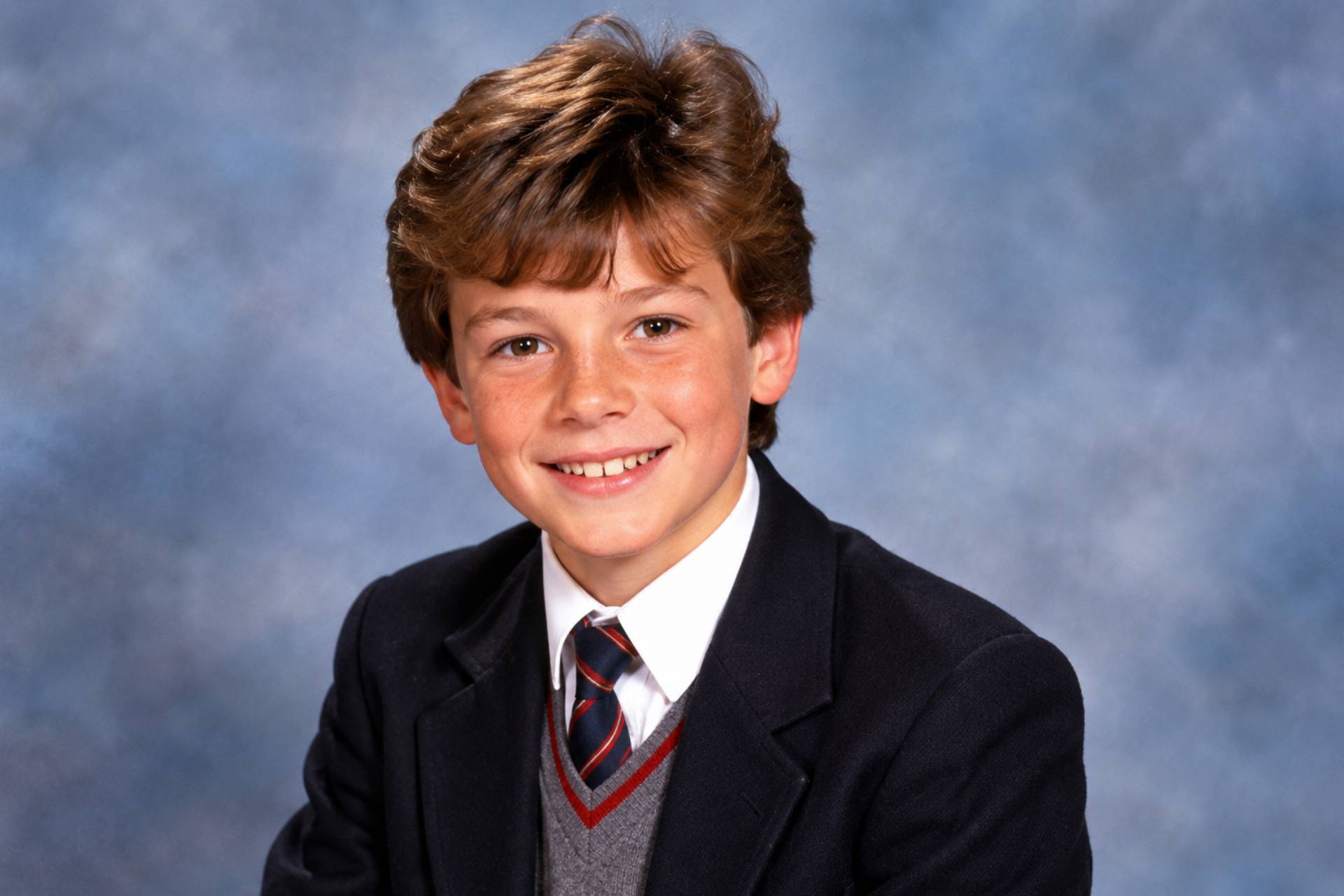
School photographs are among the most familiar images kept in British family albums. Some show individual pupils against a plain background. Others contain classes arranged in rows, with teachers at the sides and several children looking less than delighted to be there.
AI often makes a British 1980s school look like an elite boarding school from a much earlier decade. It adds old wooden desks, severe teachers, traditional caps and grand historic buildings whether they suit the setting or not.
Real schools varied widely. A Victorian primary school, a post-war comprehensive and a newer suburban building could all exist during the same year. Classrooms might contain chalkboards, wall charts, exercise books, metal-framed chairs, overhead projectors, cassette recorders or early computers.
Details that make the scene believable
- A simple blue-grey or mottled studio backdrop
- A modest school jumper or blazer
- A plain shirt, tie or polo shirt where appropriate
- Natural, age-appropriate hair
- Slightly awkward posture
- Soft studio lighting or direct school-photography flash
- A simple stool or standing pose
- Natural teeth and skin texture
- No excessive make-up or adult fashion styling
School uniform differed between schools, and not every pupil wore a blazer. If you are recreating a particular school, use genuine family knowledge or historical photographs rather than guessing.
For a class photograph, preserving individual faces becomes harder. Start with a smaller group or accept that the AI may need several attempts. Check hands, spectacles, ties and badges carefully.
Prompt
Turn the child in the uploaded photograph into a realistic British school portrait taken in 1986. Preserve the child’s exact facial identity, age, natural skin tone, hair colour and body proportions. Dress the child in a simple navy school jumper over a pale shirt, with natural period-appropriate hair and no adult styling. Place the child against a softly mottled blue-grey studio backdrop in a straightforward seated pose. Use balanced school-photography flash, mild film softness, natural skin texture and the appearance of a clean 1980s colour print. Exclude grand boarding-school scenery, old-fashioned caps, modern logos, heavy make-up, cinematic lighting and excessive retouching.
Common mistake to avoid
Do not make the child look older, more glamorous or unnaturally perfect. The slightly nervous smile and formal posture often make a school photograph recognisable.
5. A British Music and Nightlife Portrait
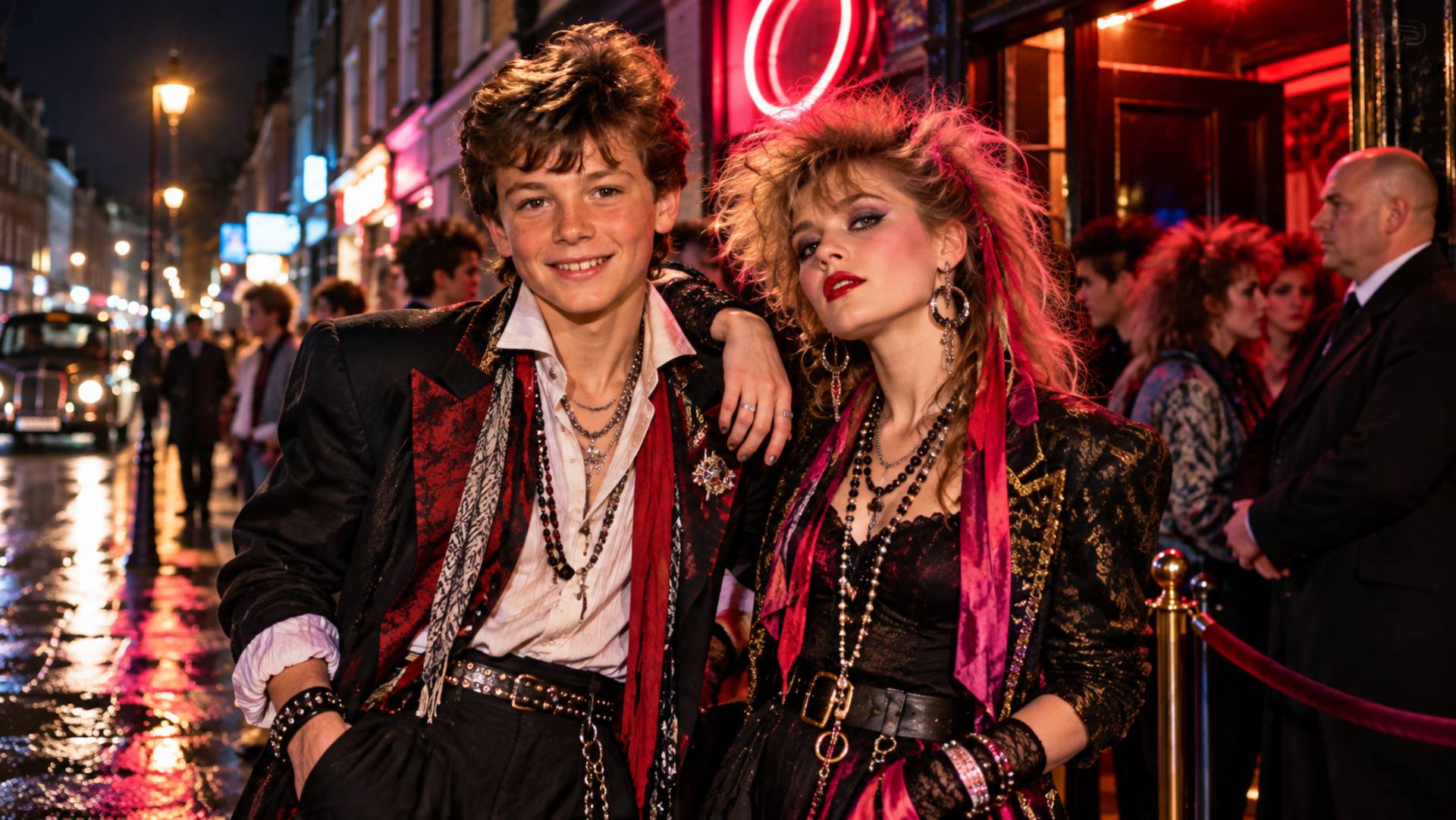
British music supplied some of the decade’s strongest fashion and visual identities. Synth-pop, post-punk, New Romantic, ska, reggae, heavy metal, indie and emerging dance culture all occupied different spaces. There was no single 1980s nightlife look.
This scene requires the clearest creative choice. A New Romantic club portrait should not be mixed with heavy-metal clothing, punk hair, a disco backdrop and late-decade rave lighting. Choose one musical culture, one year and one kind of venue. For effective AI Retro Scene Recreation, keeping those choices consistent is more convincing than combining several unrelated styles simply because they all belong to the same decade.
A local disco or working men’s club will look different from a fashionable London nightclub. A small live-music venue will have tighter space and rougher lighting than a television performance. The setting should explain why the person is dressed that way.
Details that make the scene believable
For a New Romantic-inspired portrait:
- A ruffled shirt or velvet jacket
- Carefully applied make-up
- A dramatic but controlled hairstyle
- A dark club interior
- Coloured stage or dance-floor light
- A confident, theatrical pose
For a more ordinary local night out:
- A patterned blouse, smart shirt or simple dress
- Modest jewellery
- A community hall, pub function room or small disco
- Basic coloured lights
- Friends talking or dancing in the background
- Direct flash from a compact camera
Avoid copying a specific musician’s face, outfit or album cover. Take inspiration from a broader movement and create an original character.
Prompt
Reimagine the person in the uploaded photograph preparing for a British New Romantic club night in London in 1982. Preserve the person’s recognisable facial identity, age, natural skin tone and body proportions. Use an original outfit consisting of a restrained ruffled shirt, dark velvet jacket, subtle jewellery and carefully styled period hair, with expressive but tasteful make-up. Place the person near the entrance of a small atmospheric club with dark walls, a few coloured lights and naturally dressed people softly visible behind them. Use direct event-photography flash, fine 35mm grain and realistic early-1980s colour. Do not imitate a specific musician, copy an album cover or add modern phones, LED screens, luxury styling or excessive neon.
Common mistake to avoid
Do not describe the image only as “1980s music”. Select a movement and date. Specificity prevents the AI from combining unrelated subcultures into a costume.
A Reusable Prompt Formula for British 1980s Scenes
Once you understand the five examples of AI Prompts for 1980s images, you can build your own scene with this formula:
Uploaded photograph and identity instructions + exact year + specific British location + reason for the photograph + ordinary period clothing + two to four setting details + camera and film style + modern items and clichés to exclude
For example:
Transform the uploaded photograph into a believable British scene from [year] in [location]. Preserve [identity details]. Show the person [activity or occasion], wearing [specific clothing]. Include [two to four period details]. Photograph it using [consumer snapshot, documentary, school studio or event style] with [lighting and film treatment]. Exclude [modern objects, incorrect styles and unwanted effects].
The formula works because every instruction supports the same story, whether you are building an ordinary family snapshot or interpreting Famous 1980s UK Scenes through a more personal setting.
How to Make the Result Look More Authentic
Keep the image slightly imperfect
Family albums contain tilted horizons, firm flash shadows and people who were not ready for the shutter. Ask for gentle imperfection without damaging the picture.
Do not overuse film effects
Fine grain and slight softness are often enough. Heavy scratches, dust and orange colouring can make the image look artificially aged.
Decide whether the print is new or old
A photograph developed in 1986 would not necessarily have looked faded in 1986. Specify either a newly developed period print or a print viewed after decades in an album.
Keep older possessions in the scene
People did not replace every piece of furniture or clothing when a new decade began. A 1970s chair in a 1987 room can make the picture more believable.
Generate again when faces change
Do not accept a visually attractive result if the person is no longer recognisable. Strengthen the preservation instruction, simplify the scene or reduce the number of people.
Privacy, Consent and AI Labelling
Only upload photographs you have the right to use. Obtain permission before using another person’s face, particularly when the image includes children or relatives who may not want their photograph processed by an AI service.
Check the platform’s current privacy, image-storage and commercial-use terms. Avoid uploading photographs containing sensitive information in the background.
An AI-generated scene may look like a real photograph from a family archive. Label it clearly when viewers could misunderstand its origin. “AI-generated British 1980s-style portrait” is simple and accurate.
The image can evoke history, but it should not be presented as evidence of an event that never happened. That distinction is particularly important when Recreating British History With AI, because a realistic-looking image can easily be mistaken for genuine archival material when its origin is not clearly explained.
FAQs
Five Scenes, Five Different Versions of British Life
The British 1980s cannot be reduced to neon colours, pop-star clothes and famous London landmarks. Its most convincing images come from ordinary experiences: relatives gathered around a gas fire, children sheltering behind a seaside windbreak, shoppers walking past a local record shop and pupils trying to smile for the school photographer.
Music and nightlife brought glamour and experimentation, but even those scenes become more believable when they are tied to a specific year and cultural movement.
Choose one of the five ideas and build it carefully. Preserve the person, select a real setting, keep the objects restrained and match the camera style to the occasion.The result should not simply announce “the 1980s”. The strongest AI-Powered 80s Nostalgia feels more specific: like a particular photograph that a British family might genuinely have kept.



 in London.